The Agency Side: One Landing Page Becomes the Whole Website
This is something I tested on a project, and honestly, I did not see where it was going at the time.
A client needed help with conversions. We ran a CRO audit and sent them a clear list of recommendations. Change the hero section. Update the form. Fix the CTAs. Straightforward stuff.
The problem? They had no developer.
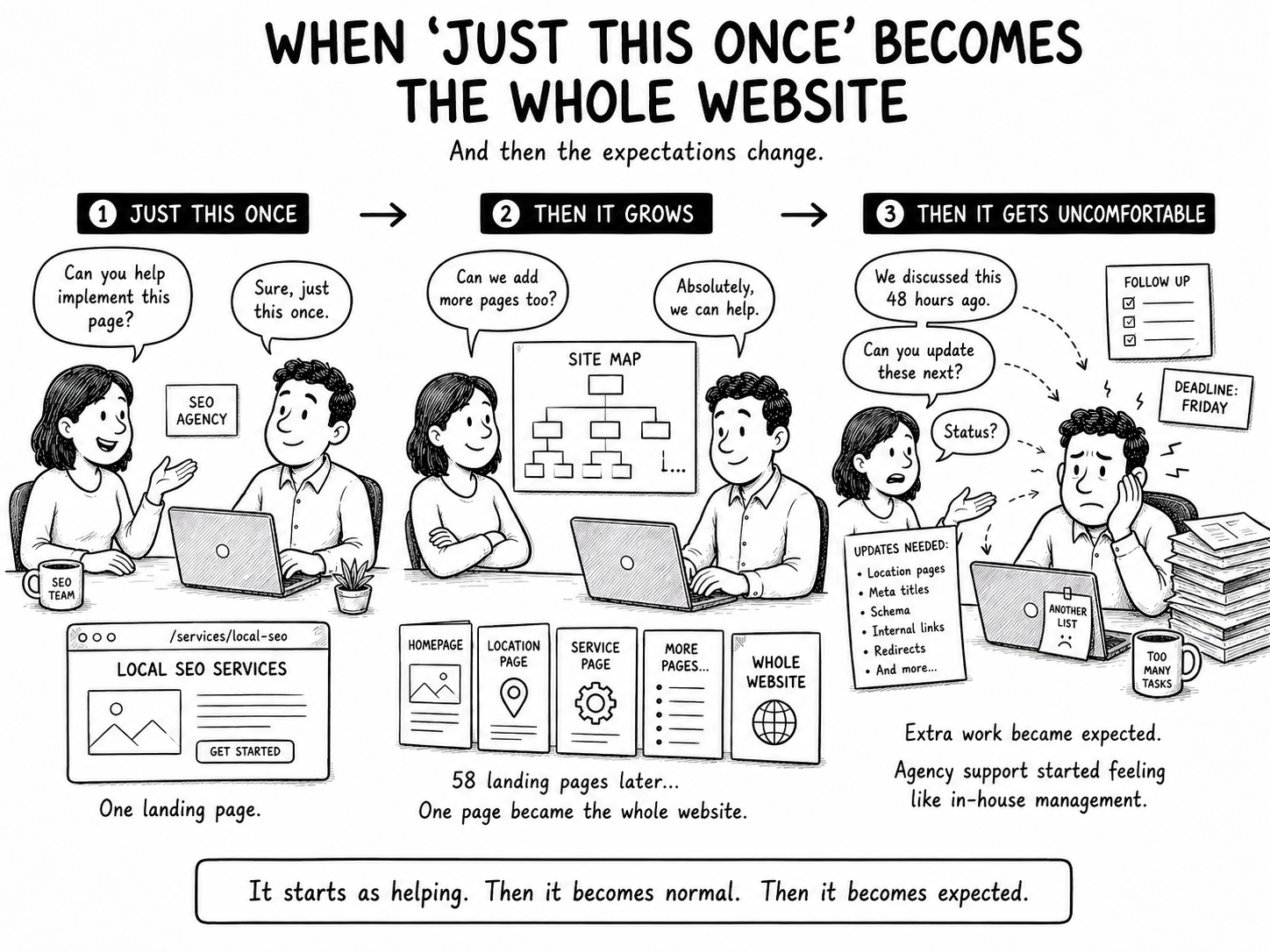
So they asked if we could help implement it. Just this once. We said yes. We built a service page template. Looked good, converted well. Client was happy. We were happy.
Then they needed a location page. Then the homepage. Then a few more pages. And within about two months, we had redesigned their entire website.
Conversions improved significantly. The client was genuinely pleased. And so were we, at first.
Then it happened with a second client. We sent recommendations. They said: “I built this site myself and I am not great with it. Can you just do it? I do not have budget for a developer.”
We helped. Because what else do you do?
Then a third client. Then it became a pattern.
At one point, we were updating 58 landing pages for a client. As part of the SEO work. Which it absolutely was not.
And that is the strange part. The work that expands your role rarely arrives with a title change. It just shows up, one request at a time.
Sometimes those requests are client-facing. Sometimes they are self-imposed, like trying to understand new developments such as the Generative AI Report in Search Console.
Who is to blame? Honestly, us. We are. We could not say no.
Part of it is the client situation. No budget. No developer. Nowhere else to go. You feel bad saying no.
Part of it is the agency structure. Some agencies sell themselves as a full-service partner — one place for everything. Which sounds great until the SEO team is doing web design.
And a big part of it is fear.
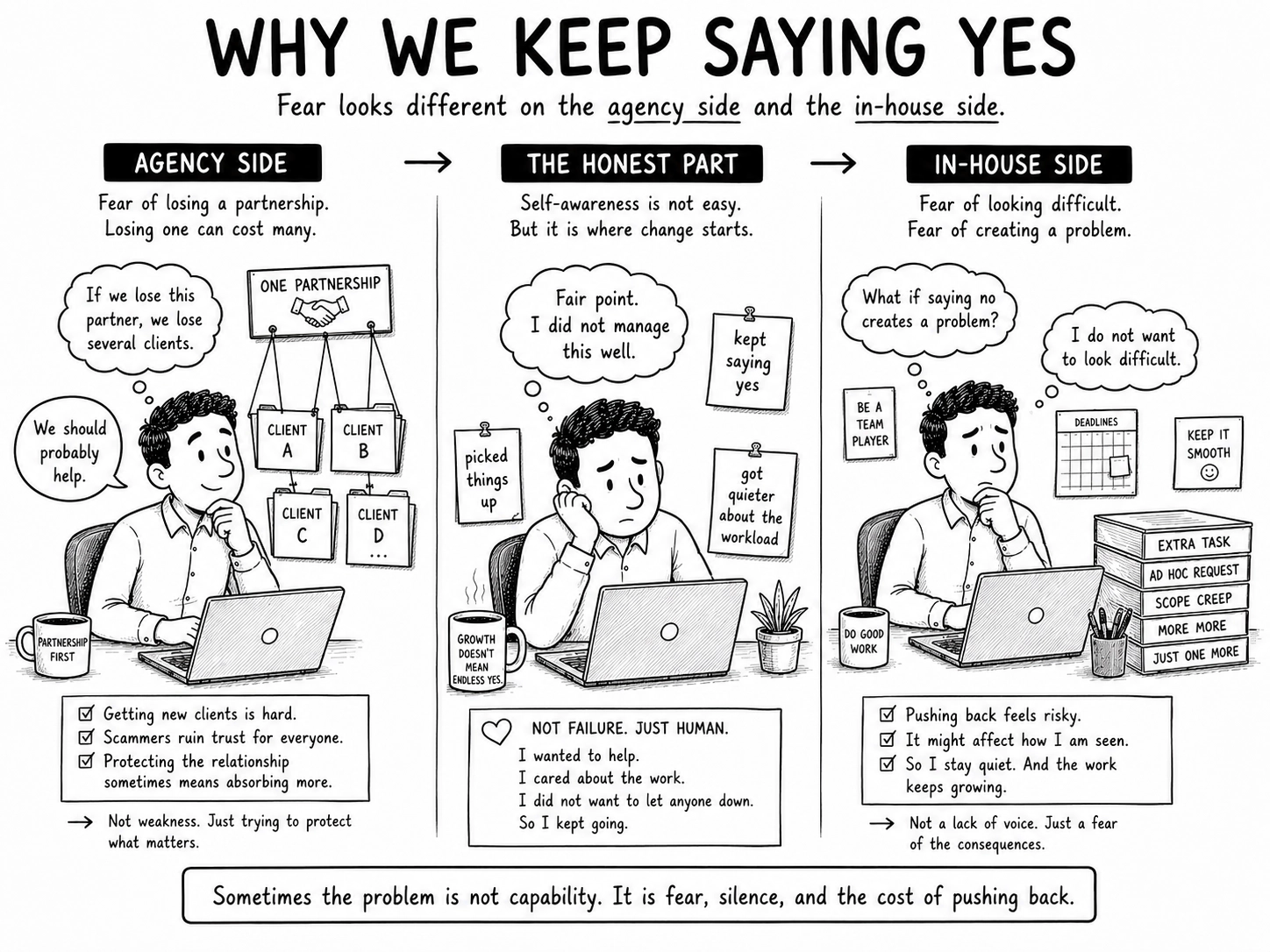
Losing one agency partnership in a white label setup does not mean losing one client. It can mean losing five, eight, ten clients in one go. That is a serious financial hit. So you keep saying yes. You keep absorbing the work. And gradually, redesigning websites becomes part of what the SEO team does.
Nobody agreed to that. It just became normal.
The Bit Where It Gets Really Uncomfortable
Here is the version of this story that does not get told enough.
Sometimes the client is not even happy with the extra work. They just expect more of it.
We had a client where the team redesigned the entire website. A lot of effort. Solid work. And instead of appreciating it, the client started sending lists.
Literal lists. With dates and times. “On this date at this time we discussed this. It has been 48 hours. Why is it not done?”
We went from delivering something well beyond the scope of the retainer to being managed like an in-house team on a deadline.
And when we tried to have the conversation about what was actually included — they pointed out that we started this work. Which is completely true. We did start it. We opened that door.
You hired an agency. Not an in-house team. But once you start acting like one, that distinction disappears fast.
That is the trap. The moment extra work becomes expected, you lose the ability to push back without it feeling like you are pulling away from something the client relies on.
And clients do not always say thank you. Sometimes they just update their expectations and move on.
The In-House Side: Curiosity That Quietly Became Ownership
The in-house version of this is a bit different in how it starts. But it ends in the same place.
I was brought in to lead SEO for one website. That was the brief. Clear enough.
Over time, things shifted. Someone in a similar role moved on. Their work did not disappear. It just moved. I picked up additional websites. Not through a formal conversation. Just gradually, because there was work and I was there.
Then something new came up that genuinely interested me. A completely different channel I had never worked on before. I was curious. How does it work? What are the actual levers? I wanted to understand it.
I started asking questions. Then helping. Then learning properly.
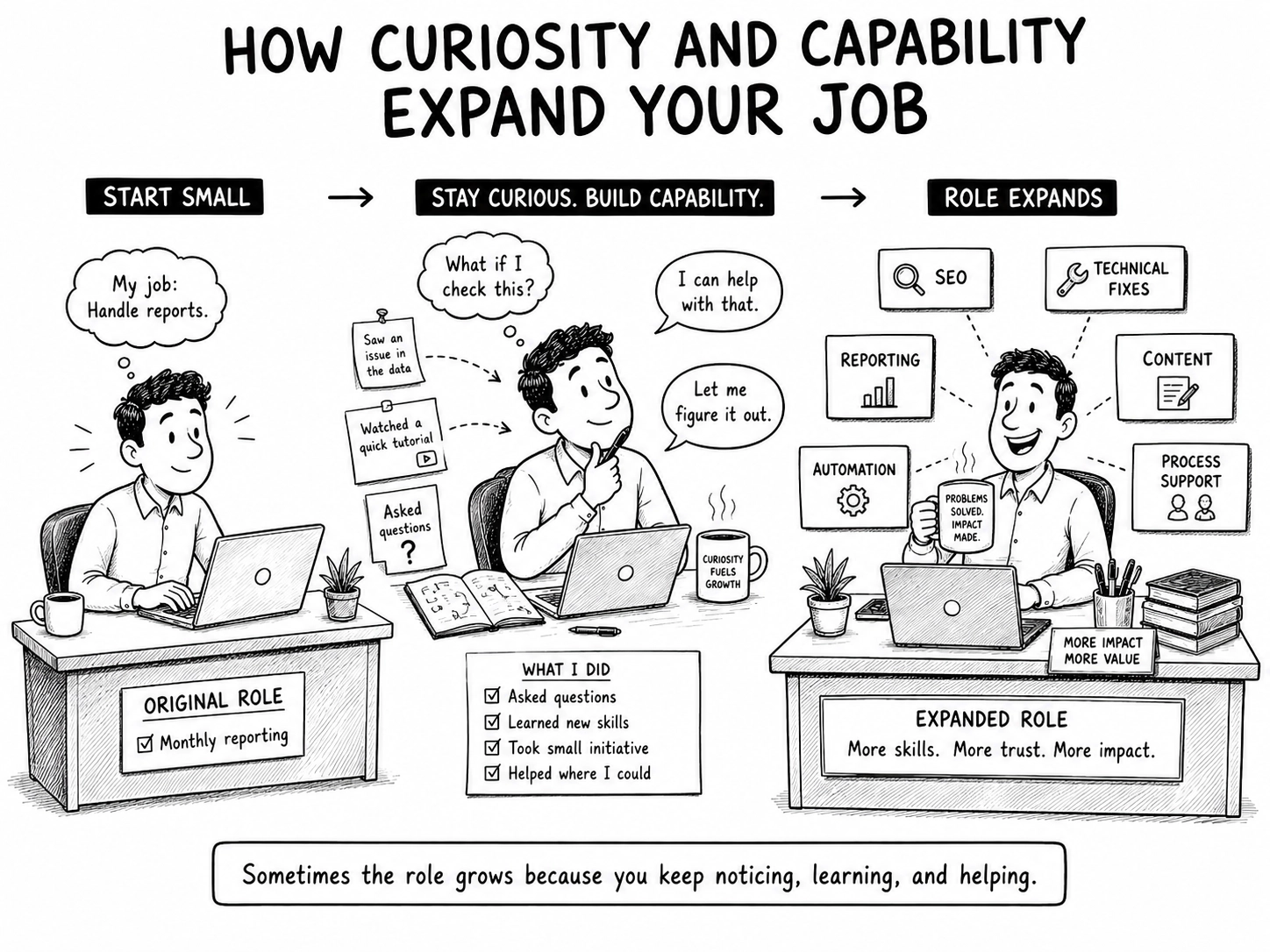
And then, without any formal agreement, I had ownership of multiple new responsibilities. My job title was still the same. My contract was still the same. But the actual work looked completely different to what I was hired for.
I was curious about something new. That curiosity turned into a permanent responsibility that nobody officially gave me.
This is something most people miss. Curiosity signals availability. Interest signals willingness. And willingness, in a busy workplace, reads as ownership.
Nobody said: here, take this. They just stopped worrying about it because someone was handling it. That someone was me.
Okay But Why Are You Crying? You Did This to Yourself.
Fair point. One hundred percent fair.
Both situations — agency and in-house — come down to the same thing. I did not manage it well. And I know that.
On the agency side, the honest answer is fear. Fear of losing a partnership is real. Getting new clients is hard. And if you are from South Asia running an agency, it is even harder.
There are job posts out there that explicitly say no freelancers from certain countries. Scammers have ruined the reputation for everyone. So when you have a good partnership, a working relationship, clients who trust you — you protect it. Even when protecting it means absorbing extra work you should not be doing.
Losing one good partner can take down a big chunk of your business overnight. That fear is not irrational. It is just expensive in a different way.
On the in-house side, it is also fear. Just a different kind.
I am a big guy physically. But I am, genuinely, a very cautious person when it comes to having difficult conversations at work. Pushing back, saying no, renegotiating scope — these things feel risky to me. What if it creates a problem? What if it looks like I am not a team player?
So I just… kept going. Picked things up. Said yes. Got quieter about the workload.
I am not good at this. I accept that. This is literally one of the reasons I started this blog — to say the things I find hard to say out loud.
Saying it here is easier. And maybe someone reading this is in the same place and needed to hear that they are not alone in it.
So Why Does This Keep Happening to People?
It is not just a personal failure. There are patterns here worth understanding.
Capability creates expectation. If you are good at something, people assume you can handle more of it. And more adjacent things. The bar moves because you keep clearing it.
Curiosity signals availability. Asking about something new reads as “I am happy to help with this.” Even if that was never what you meant.
Nobody has the difficult conversation. In agencies, nobody wants to risk losing a partnership that covers multiple clients. In-house, nobody wants to seem difficult. So the scope just grows and nobody formally acknowledges it.
Extra work becomes normal before anyone agrees to it. And once it is normal, it is very hard to walk back without it feeling like you are taking something away.
What I Would Do Differently
I am not here to give you a perfect five-step framework. But here is what I think about now.
- Name it early. The moment something outside your brief becomes a regular task, say something. Not as a complaint — just as a question. “I have picked this up — is that the plan going forward?” It forces a real conversation.
- Keep learning and owning separate. You can be curious about something without formally taking it on. Ask questions, get involved — but stay aware of when learning becomes accountability.
- In agency work, write the scope down. Verbal agreements are how scope creep starts. If the client needs implementation help, that is fine. But it should be documented and costed properly.
- Fear is a bad reason to keep saying yes. In agency partnerships, if you cannot have an honest conversation about capacity without risking everything — that partnership has a fragile foundation anyway.
One Last Thing
There is a version of this story that sounds like a success. “I started in SEO and ended up leading a much broader function.” And sometimes that genuinely is a success.
But there is another version that is more common and less comfortable. Where the scope expands, the recognition does not, and you end up doing multiple jobs under one title because you were capable, curious, and did not want to cause problems.
Both versions start in exactly the same way.
That is the part worth paying attention to.
I used to think being helpful was always the right move. It usually is. But there is a difference between growing your role and quietly being handed work that nobody else wanted to deal with. I am still working that one out — clearly.