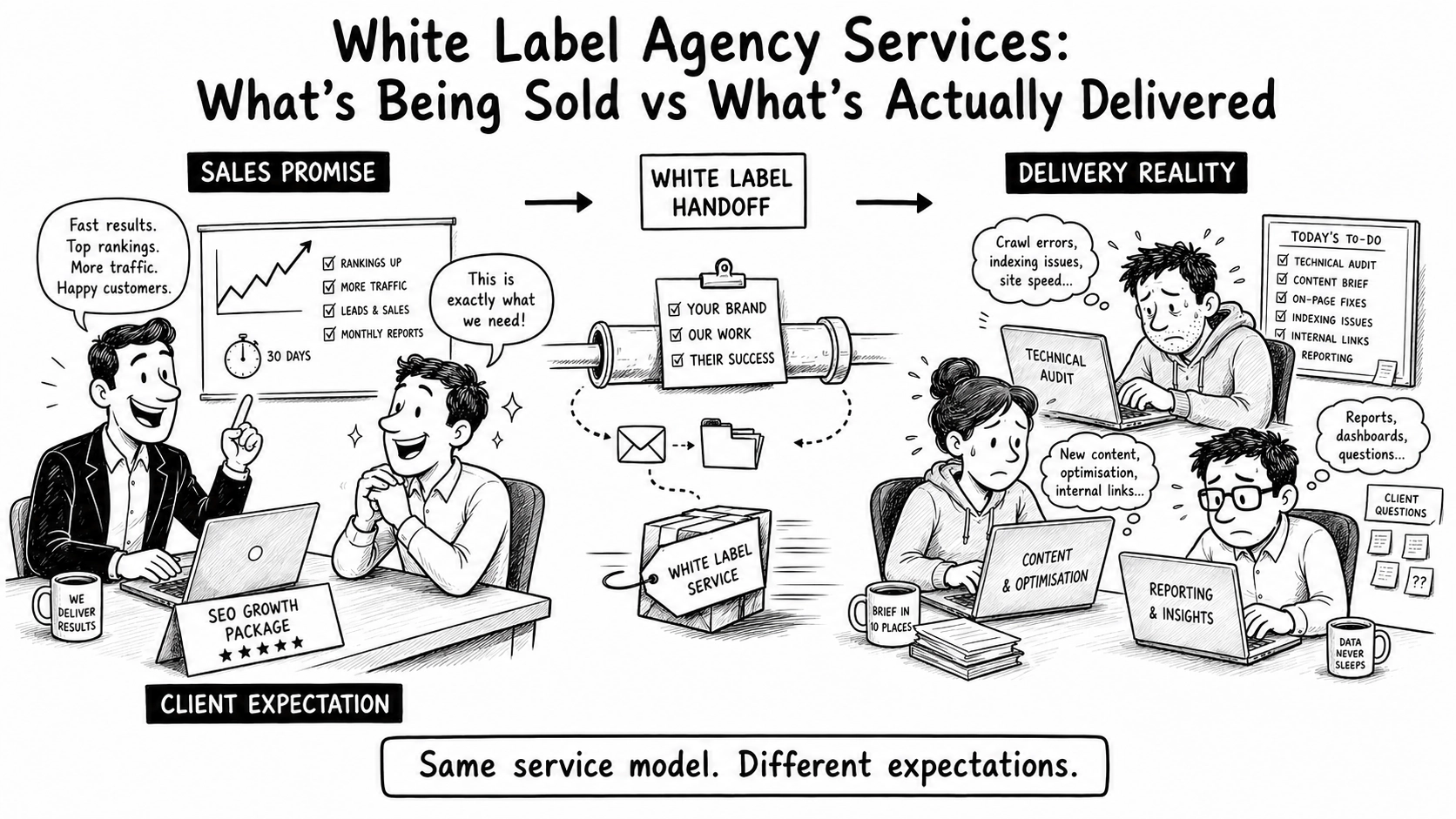
The Pricing: You Charge £3,000. We Get £600. Then You Ask Why Results Are Slow.
Let’s start with money. Because when the pricing is wrong, everything else breaks.
White label agency services run on a margin model. Simple enough. The reselling agency charges the client, keeps their cut, and passes the rest to the delivery partner. Clean in theory.
In practice? Not so much.
Here’s a real example. One agency gave the team a 25-30% cut. That means:
- Client pays the full monthly fee
- Agency keeps 75%
- Team delivers 100% of the work on 25-30% of the budget
You don’t need a finance degree to spot the problem there.
Another situation. The team had a fixed package at $600 per month. The agency was reselling it to clients for $2,500 to $3,000. No legal issue, that was the agreed model. But here’s what happens next. The client is paying $3,000 and expecting $3,000 worth of results. The team is working on $600. And when results don’t match expectations, the delivery partner gets the blame for a gap they had no part in creating.
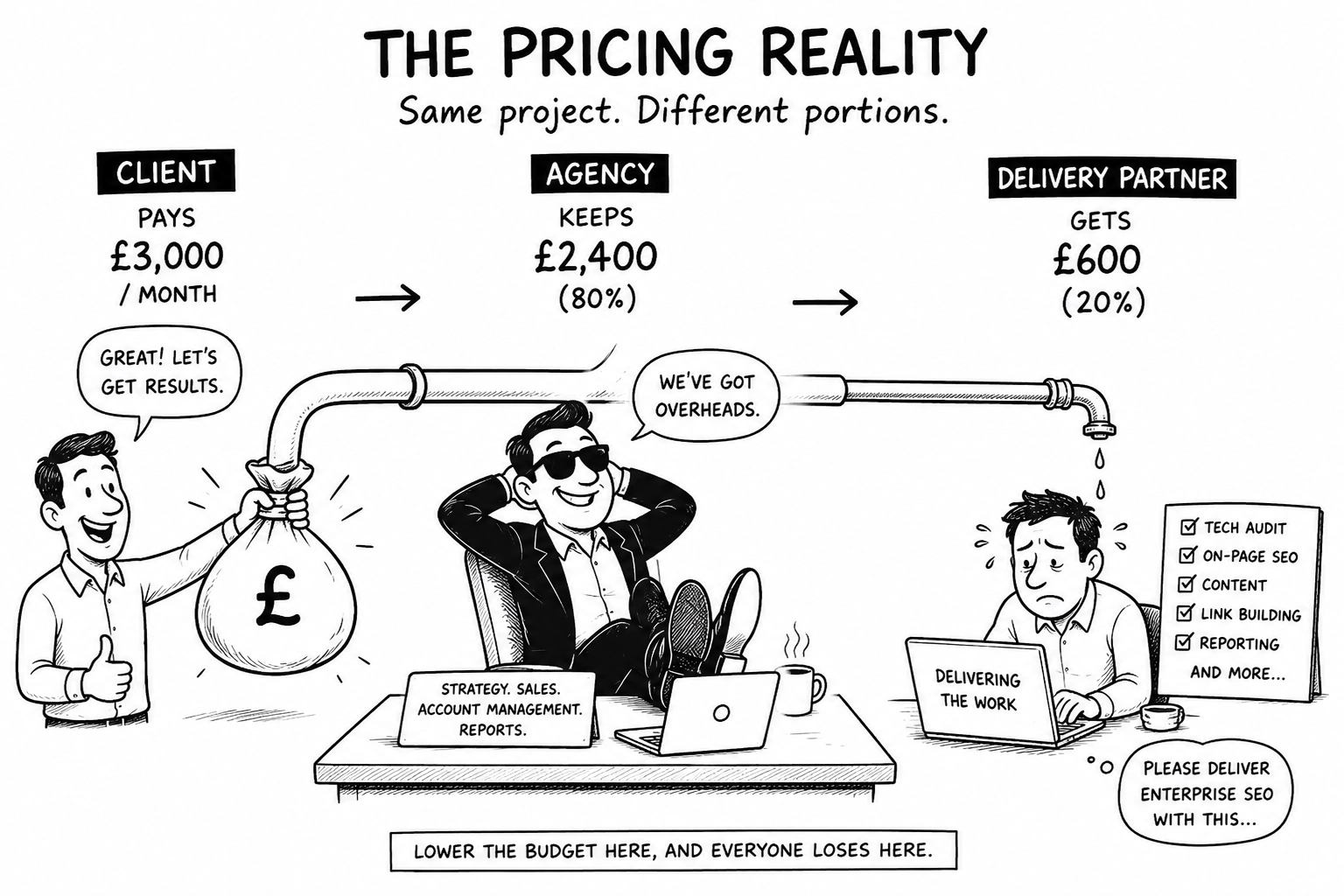
According to ALM Corp’s 2026 white label SEO report, building even a basic in-house SEO team now costs agencies over £100,000 a year per specialist. That’s exactly why they use white-label partners. But cutting the delivery budget to 25-30% and expecting full output isn’t a business model. It’s wishful thinking.
The fair split, based on real experience across multiple partnerships, ranges from 50 to 60%. At that number:
- The reseller still makes a healthy margin
- The delivery team can do the job properly
- The client gets results that reflect what they actually paid for
Below that, somebody always loses. And it’s never the agency in the middle.
No Proper Onboarding. Just Access Details and a Deadline. Good Luck.
Some agencies have no real process for setting up a new client in a white label arrangement. They win the business, send over login details, and expect the magic to begin.
That’s not a process. That’s optimism attached to a retainer.
Real example. The team once received a client with a global services website. Fifty service pages across multiple international markets. The monthly white label budget? $400. The mismatch was flagged immediately. The agency owner was told directly that the budget needed to match the scope of the site and the amount of work involved. It didn’t move.
When results didn’t come, the team took the blame. Despite raising the problem from day one. In writing.
That’s the part that stings. Not the lack of results, but being accountable for a failure that was set up before the first task was assigned.
Good onboarding for any white label arrangement should cover at minimum:
- Site audit findings: What is the real technical condition of the website?
- Budget alignment: Does the agreed budget actually cover what needs to be done?
- Scope definition: What can realistically be delivered each month at this level?
- Communication ownership: Who manages the client relationship and who handles problems?
Without those four things, the delivery partner spends the entire engagement managing expectations they had no say in setting.
‘Positive Results in 3 Months.’ Mate, Google Isn’t Your Personal Assistant.
Agencies don’t oversell because they’re dishonest. They oversell because closing a client is hard. Telling a prospect results take 6 to 12 months doesn’t always win the pitch. So timelines get compressed, promises get made, and then the brief lands with the delivery team.
Here’s a real one. The team received an e-commerce client with multiple domains. Hreflang was broken across the site. Duplicate content was spread across product listing and product detail pages. The agency had already told the client: positive results in 3 months.
When the audit came back, the technical and content work combined was going to take nearly two full months at the available budget. And that’s before Google has even had a chance to crawl the changes, render the pages, re-index them, and start serving updated results.
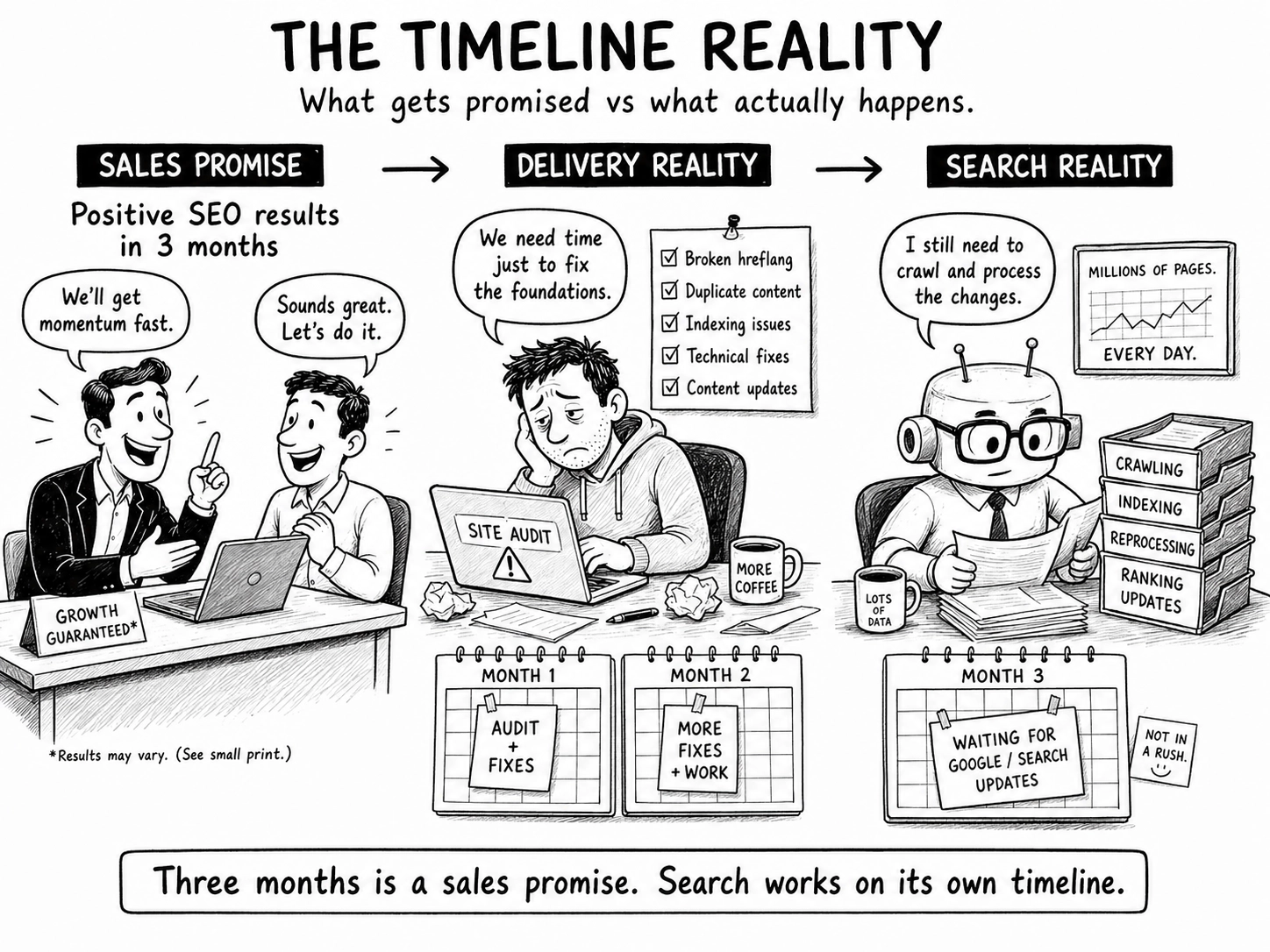
Google doesn’t crawl on request. It doesn’t index overnight. And impressions don’t appear just because a client was promised they would.
Three months is not a realistic promise for a technically broken website. It’s a sales target dressed up as an SEO strategy.
According to Ahrefs data cited in SEOmator’s 2026 AI SEO report, organic click-through rates have already dropped 61% where AI Overviews appear. The search environment is harder than ever. Promising fast results on broken foundations isn’t ambitious. It’s setting up a situation where the delivery team fails and the client walks.
SEO Has Changed. Some Agencies Are Still Selling 2019 Strategies in 2026.
SEO in 2026 is not the same discipline it was a few years ago. Not even close.
AI Overviews dominate the top of search results. Brand visibility, entity authority, and multi-channel presence matter more than ever. Relying on SEO alone as the primary marketing channel is, for most businesses, no longer realistic. SEO is one part of a much bigger picture now.
The delivery team knows this. But in many white label arrangements, they’re not allowed to say it to the client. The reasoning is simple: if a client hears that SEO alone won’t move the needle, they might cancel the retainer. So the agency says nothing. The team keeps working against a brief that doesn’t match how search actually works anymore.
My own position has always been honesty first, even when it means walking away from a project.
A personal injury law firm in New York came through as a potential client. One of the most competitive local SEO markets in the world. The honest answer was that the team didn’t have the capacity to rank there. So the project was turned down.
The client respected the transparency. They came back later with a different project that was a proper fit, and that one went well.
Honesty isn’t just a principle. It’s actually better for business.
And yet, agencies keep selling SEO as a guaranteed fix for businesses that need a proper marketing strategy, not just backlinks and blogs.
Now AI Is Here. And Apparently That Means We Should Work for Less. Interesting.
This is the newest development in white label arrangements, and it deserves its own section.
Some agency owners have started asking delivery partners to reduce their rates. The reasoning? AI. Why pay for a technical audit when ChatGPT can produce one? Why pay for content when AI can write it? The logic sounds neat until you see what happens when it’s actually applied.
Here’s a real case study that shows exactly what happens. The SERPBiz team started working with a pet veterinary client in December 2023. The site had 41 organic visits a month. Through technical SEO, content strategy, and consistent work over roughly 18 months, that grew to nearly 9,000 monthly visits by September 2025. Over 1,600 keywords ranking, with 500+ in the top 3 positions. In September 2025, the client chose to move to an AI-based agency model. The traffic chart tells the rest of the story.
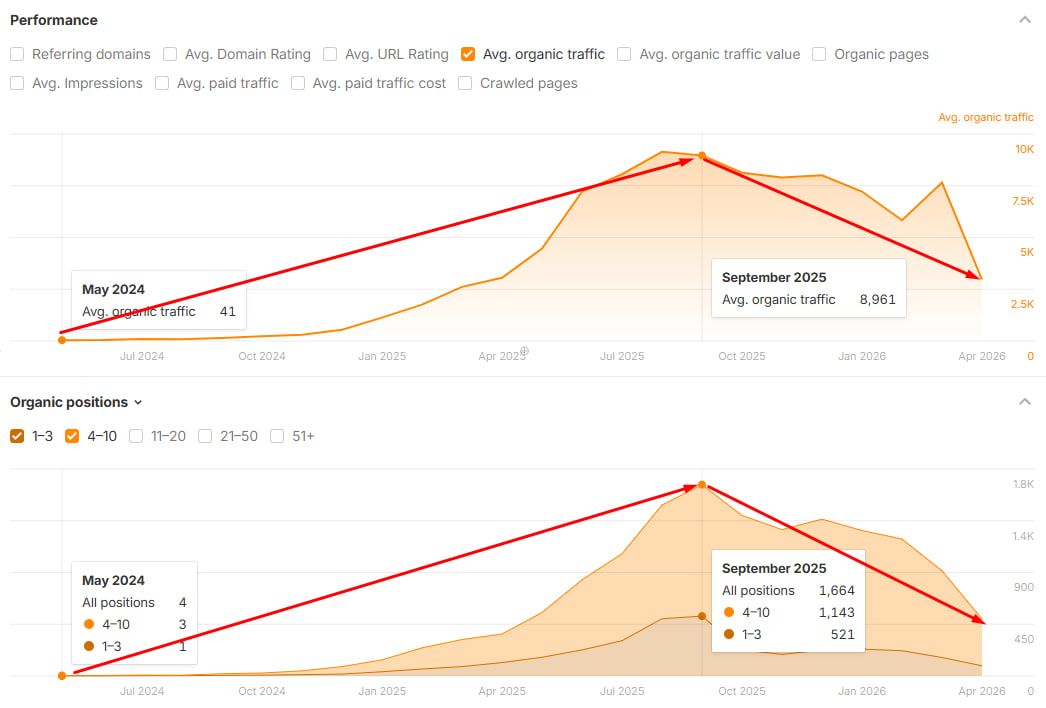
What happened next? The traffic dropped. That’s it. No plot twist. Years of structured work unwound after the switch. The case study speaks for itself.
What makes it worse is a pattern across other projects. Some agencies switched clients to AI-only models, then came back to us asking to explain to those clients why the results weren’t there. Not to fix it. Not to re-engage properly. Just to handle the awkward conversation they didn’t want to have. The team that was replaced by AI is now doing the unpaid customer service for AI’s failures. Make that make sense.
There’s a 2026 stat worth quoting here. According to Demandsage’s AI SEO report, 69% of SEO specialists will have their role reshaped by generative AI. Note the word reshaped, not replaced. AI changes the workflow. It doesn’t remove the need for people who understand what they’re doing.
And then there’s the communication problem.
Previously, client queries came through properly. Questions would reach the team, the team would respond with informed answers based on what they were actually implementing. That process had context.
Now some agency owners or their team members handle client queries using ChatGPT to generate answers on the spot, without checking with the delivery team first.
Here’s a real example. A client asked whether Google Reviews could be integrated directly into service pages. An agency team member, clearly working from a quick AI-generated response, said yes, they would integrate Google Reviews directly through schema markup.
Aggregated ratings in schema for product pages? Absolutely. But pulling Google Reviews directly into schema on service pages? That’s not how it works. The delivery team still hasn’t found a clean way to implement what was promised. And now someone has to explain to the client why what they were told isn’t happening.
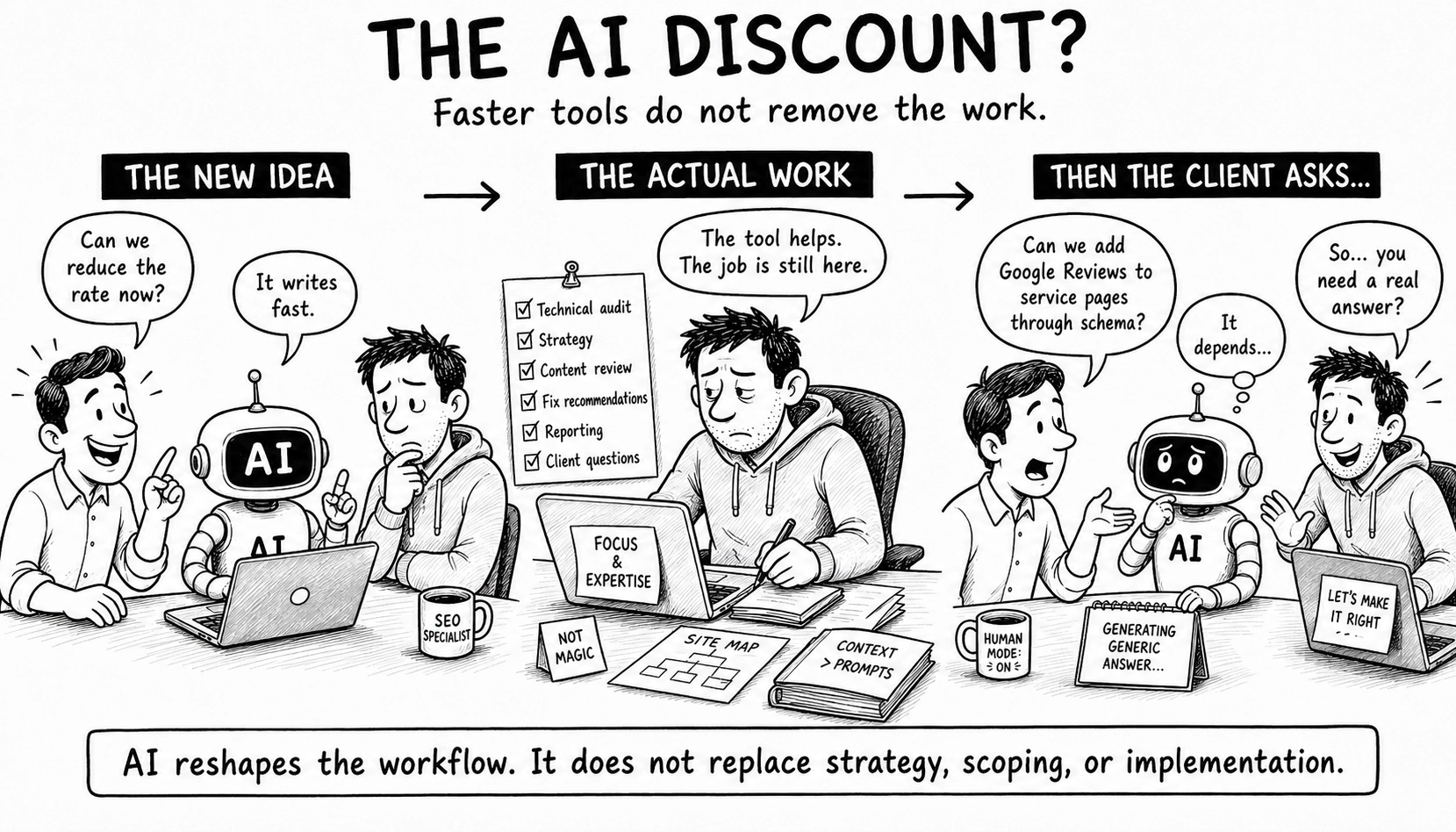
AI is a useful tool. Nobody is arguing otherwise. But using it to answer technical scoping questions without checking with the team doing the work isn’t efficiency. It’s creating problems and billing someone else to clean them up.
So Why Does the Team Still Do It? Honest Answer: Geography Is a Real Thing.
If white label arrangements come with all of these problems, why continue? Fair question.
The honest answer is survival and geography. SERPBiz is based in Bangladesh. Reaching clients directly in the US, Australia, or Canada is genuinely hard. Not because the work isn’t good, but because local business owners in Western markets tend to prefer working with local agencies. That’s the reality. Saying otherwise doesn’t help anyone.
The team tried direct outreach. Registered businesses. Looked at hiring local representatives. Invested in marketing. It didn’t gain the traction needed. So white label partnerships, despite everything, remain a practical route to doing meaningful work for clients who would never otherwise find the team.
What makes it worth it is the quality of the work. I spent a year working with one of the largest white label SEO agencies in the US. What I saw being delivered for the fees charged was, to put it carefully, not impressive. Basic work. Template approaches. Minimum viable effort.
The gap between that and what the SERPBiz team was producing for a fraction of the budget was real. I’m not saying that to be dramatic. I know what good SEO work looks like.
The problem isn’t the model. The problem is who the model protects when things go wrong. Right now, it’s not the delivery partner.
Before You Come For Me in the Comments…
Yes, I used AI to help write parts of this blog. And yes, I am someone whose team lost clients to AI. I am aware of how that looks. But using AI to help structure content faster is not the same as replacing the people who understand strategy, implementation, and what actually works in search. That is the whole point.
Now, a few arguments I can already see coming. Let me get ahead of them.
- “You’re just bitter because you lost clients to AI.”
Sure, maybe. But bitter people don’t grow sites from 41 to 9,000 organic visits. The numbers are there. If calling out real problems makes someone bitter, fine. I’ll wear that badge.
- “If your work was good enough, clients wouldn’t leave.”
The client left when traffic was at 9,000 a month. Up from 41. If that’s not good enough work, I don’t know what is. People leave for budget cuts, internal politics, and shiny new tools. It’s not always about the results.
- “Why are you exposing your agency partners publicly?”
No agency is named here. Not one. These are patterns that keep repeating, not personal callouts. If someone reads this and feels seen, maybe that’s worth sitting with.
- “Bangladesh-based agencies are cheap for a reason.”
The same team that built those 9,000 monthly visits is based in Bangladesh. The US agency I spent a year working with? Premium fees. Very average work. Geography doesn’t decide quality. Process and attitude do. But I know this argument won’t go away, and that’s fine.
- “AI tools are good enough now. You’re just protecting your business model.”
I use AI tools. Nobody here is anti-AI. The problem is using ChatGPT to answer technical client questions without checking with the team actually doing the work, then being surprised when what was promised can’t be delivered. That’s not an AI problem. That’s a process problem with an AI label on it.
- “Why didn’t you just walk away from bad clients instead of complaining?”
Some projects were turned down. The New York personal injury law firm mentioned earlier is one. But walking away from every difficult arrangement isn’t realistic when you’re a small team in Bangladesh trying to reach clients in the US. That kind of freedom comes with a very different set of circumstances.
- “You’re recommending SERPBiz at the end. This is just a sales pitch.”
Every practitioner who writes anything mentions something at the end. Podcast guests plug their newsletter. Conference speakers mention their agency. I mentioned a team I know well and believe in. If that disqualifies everything else written here, then no one with real experience should ever write anything. Odd standard.
- “South Asian agencies are part of the race to the bottom pricing problem themselves.”
Fair point. Low delivery costs do let agencies sell cheap packages that probably shouldn’t exist. That’s real. But the answer to that isn’t squeezing the delivery partner to 25-30% and expecting full output. The pricing problem runs both ways, not just one.
What Actually Needs to Change
The white label model isn’t broken beyond fixing. It works well when both sides are honest about what they’re doing. The problems outlined here aren’t inevitable. They’re the result of specific choices that agencies make, usually under commercial pressure, that create problems for everyone downstream.
If you’re an agency using white label agency services, a few questions worth sitting with:
- Is the pricing split you’re offering actually enough to do the work properly?
- Was the client onboarded with a realistic understanding of what SEO can and can’t deliver, and when?
- Are you giving the delivery team the information they need, or just access and a deadline?
- Are you using AI to answer client questions without checking with the team responsible for implementation?
- Are you selling SEO as part of a real strategy, or as a standalone fix for a business that needs more?
These are not difficult questions. But most agencies don’t ask them because the answers are inconvenient.
If you’re looking for a white label partner that works with this level of transparency, the SERPBiz team is worth a conversation. Not a hard sell. Just an honest mention from someone who has seen the inside of this industry for a long time.
Get in touch if you want to talk about what a properly structured white label arrangement actually looks like.