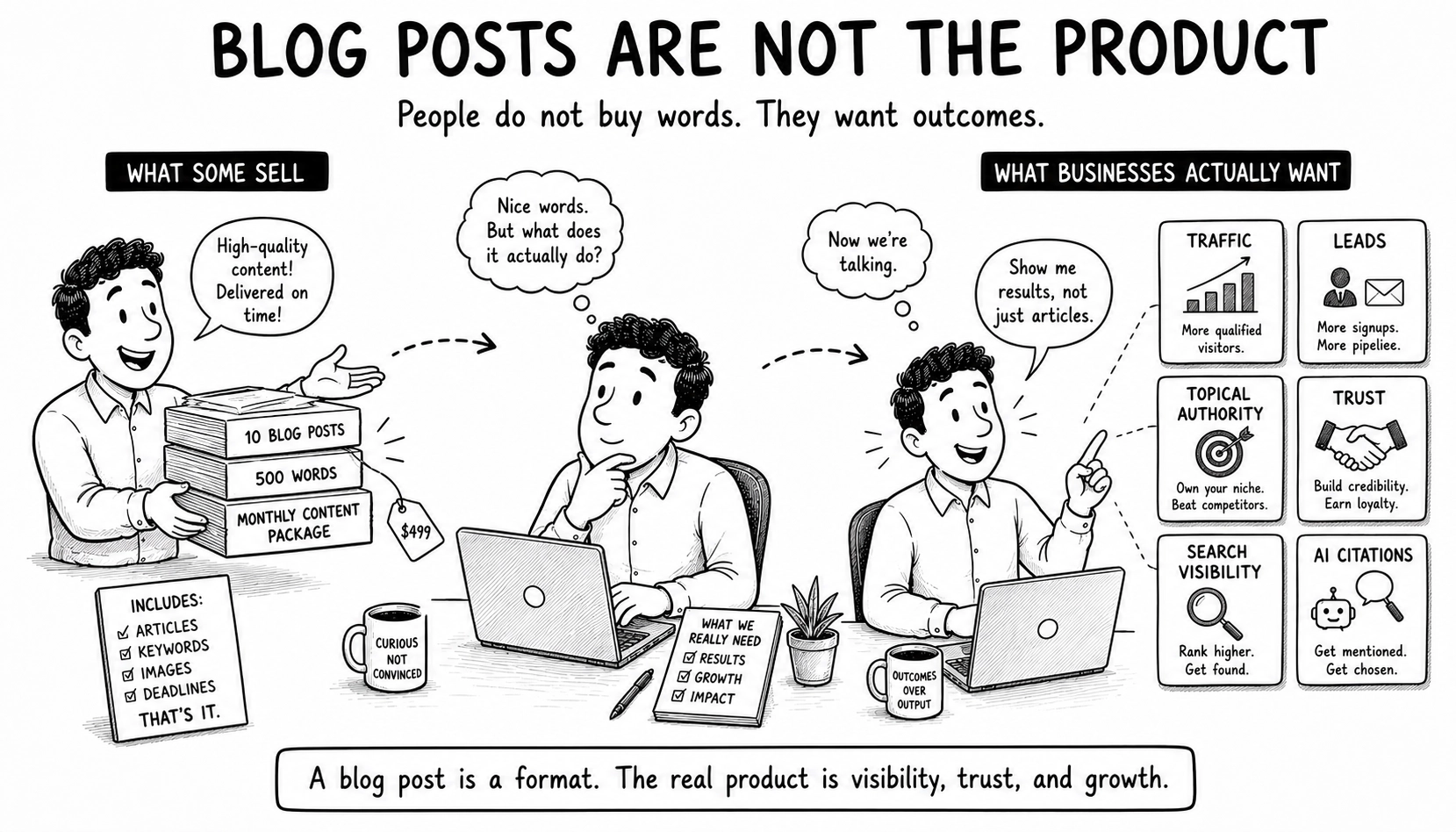
What Eli actually argued
His point, stripped down: real SEO means putting your product in front of someone at the exact moment they are ready to act. Not ranking a “how to do X” article because it has nice search volume. Information is a commodity. The reader takes it, leaves, and never comes back.
He uses Tinder, SurveyMonkey and Comcast as examples. All cases where the smart move was an action page, not an article. And he is completely right about every one of them.
Where he is 10000% correct
Agencies do sell blog posts as “SEO.” I have not just seen it, I have done it myself. Two posts a month, a keyword target, a word count, an invoice. Everyone nods. Nobody checks whether a single one of those posts ever brought in a customer.
That part is true, and Eli deserves credit for saying it out loud. Most people in this industry never will. And if I am honest, I cannot shout about it too loudly either, because saying the quiet part out loud is bad for business.
But here is the bit nobody writes about (agency side)
Here is the uncomfortable truth from inside an agency. You have to sell something the client can actually see.
Most clients do not care about the technical work. I do not mean that as an insult, they are just busy running a business. When you fix a canonical tag, clean up crawl waste, or sort out a messy faceted navigation, the client sees nothing. No screenshot. No shiny new page. Just an invoice and your word that it mattered.
A blog post is different. It is visible. It shows up on the site, the client can read it, share it, and feel like the money is doing something. Sometimes the blog is not there to convert the customer at all. It is there to keep the client calm enough to keep paying for the technical work that actually moves the needle. That is not a scam. That is budget survival.
You cannot tie everything to revenue. Part of the job is keeping the lights on so you can do the real work behind the curtain. I have written before about the gap between what an agency sells and what it actually delivers, and the blog often sits right in the middle of that gap.
And here is where Eli’s argument meets my actual job (in-house side)
Now let me switch hats. In-house, I am the SEO lead for an ecommerce business, and our blog is not a sad pile of “ultimate guides” gathering dust. It is our awareness layer, and it pulls its weight.
We push our blog content through email and social. The traffic is not huge, but it is real, and some of it converts. Our customers still like reading a proper guide before they buy. So every post carries a clear CTA, links to relevant products, and highlights real features instead of rambling about a topic for 1,500 words.
So what is actually going on here?
I think the real variable is distribution, and Eli mostly skips past it. It is also a sign of how much the SEO job has quietly expanded — we are expected to think about channels and brand now, not just rankings.
If you are a pure SEO provider and your blog just sits on the website hoping Google notices, then yes, it is probably doing very little beyond a bit of internal linking and some topical authority. Eli is right about that blog.
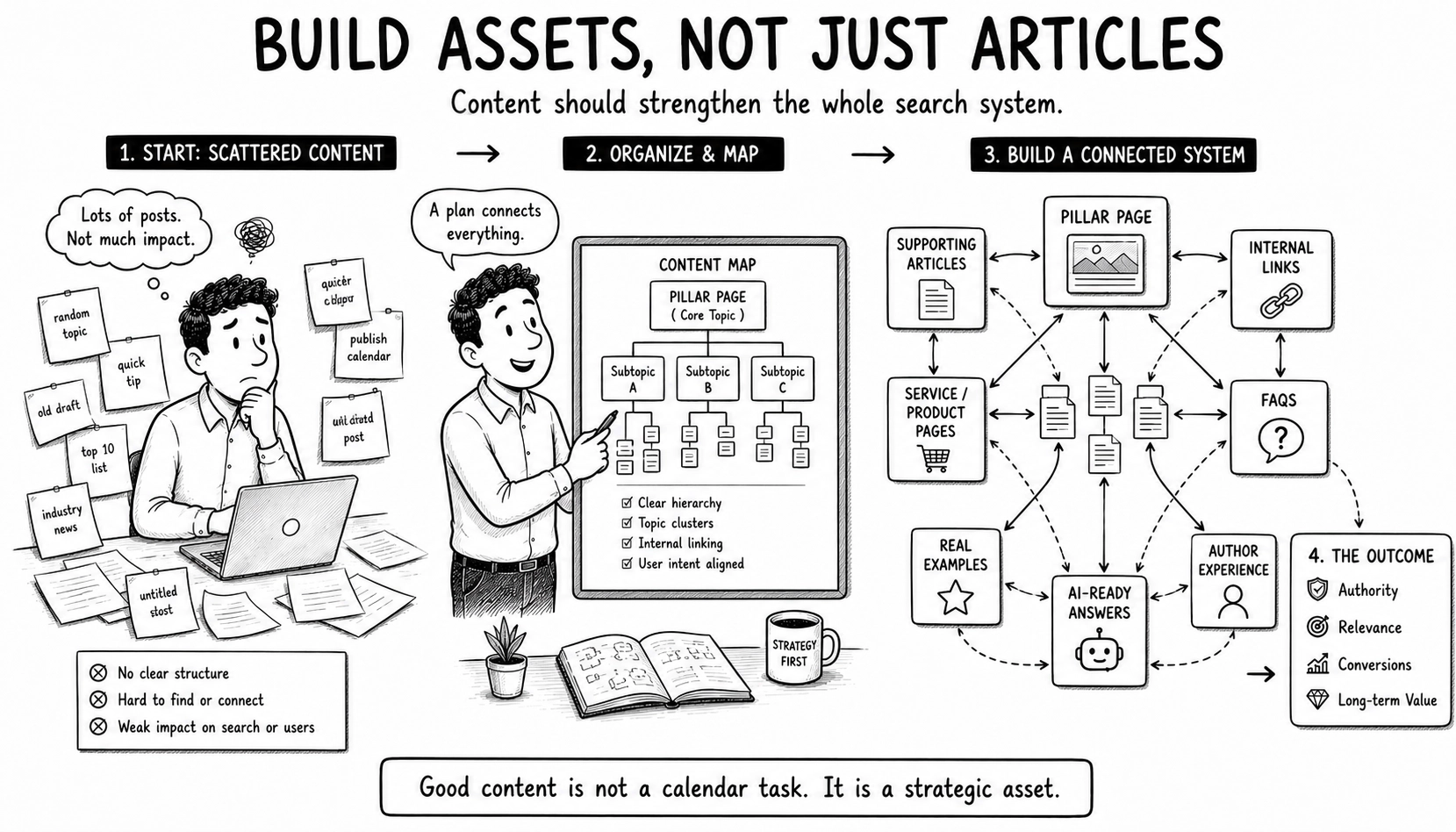
But the moment you push that same content through email, social, a newsletter, a community, it stops being a lonely page and starts building a brand. And in the GEO era, where AI tools decide which brands to mention and trust, brand building is not a nice-to-have. It is the whole game. A blog nobody distributes is not SEO. A blog that feeds a brand might be one of the most useful things you do.
Where Eli would push back (and fairly)
To be fair to him, he would probably say, “Fine, but show me the conversion data.” And he would have a point. Most teams cannot prove their blog drives revenue, because they only measure last click, and informational content rarely wins on last click. Its real value hides in assisted conversions, branded search and links — the stuff bad attribution makes invisible.
So if your blog cannot show its working, Eli’s challenge stands. Prove it earns its place, or stop pretending it is SEO.
Where I land
I think Eli and I are actually agreeing, just from different chairs.
He is saying: stop calling content “SEO” when it has no intent, no action, and no proof. I am saying: the same blog post can be dead weight or a real asset, and the deciding factor is whether it has a job and a way to reach people.
So maybe the lesson is not “stop writing blog posts.” It is “stop publishing blog posts and then walking away.” Give it a purpose, give it a channel, and measure it honestly. Do that, and it stops being content pretending to be SEO. Do nothing, and Eli is completely right about you.
And here is my confession. I am about to do nothing. I will publish this, leave it sitting right here, and not share it on social, not email it, not push it anywhere. Which is the exact thing Eli was warning about. I read his point, nodded along, and then walked straight into it. So Eli, if you ever read this, you are completely right about me too.
I used to think every blog post had to justify itself in pure rankings. It does not. But it does need a reason to exist. That part I will not argue with. Not even with Eli.